
Korea Visa Rejected: Common Reasons at Ano ang Gagawin
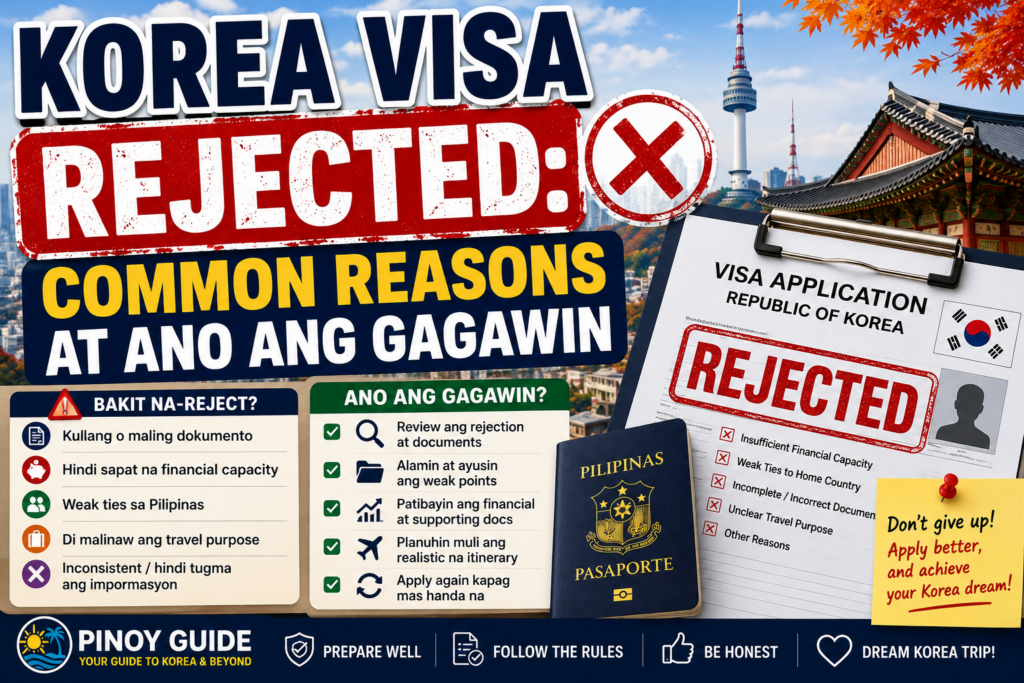
Getting a Korean visa rejection can be frustrating, especially kung matagal mong pinaghandaan ang dream trip mo to Seoul, Busan, or Jeju.
Maybe you already prepared your Certificate of Employment, bank certificate, bank statements, ITR, itinerary, and other supporting documents. You may even have enough money saved for the trip.
Then you check your application and see the result:
Visa denied.
Naturally, the first question is:
“Bakit ako na-reject?”
And immediately after that:
“Pwede ba akong mag-apply ulit?”
A Korean visa rejection does not necessarily mean you can never visit Korea. But instead of immediately submitting another application with exactly the same documents, it’s better to understand what may have weakened your first application and fix those issues before trying again.
Here are some common problems worth checking and what you can do after a Korea tourist visa rejection.
Does Korea Tell You the Exact Reason for Visa Rejection?
Not always in the level of detail applicants would like.
Visa decisions are made after evaluating the applicant’s overall circumstances and submitted documents. Therefore, trying to identify one single “secret reason” from social media stories is usually not productive.
The first thing you should do is check your official application status rather than relying on unofficial messages or third-party claims.
The Korean Embassy provides instructions for checking visa application status through the Korea Visa Portal, using information including the applicant’s passport number, English name, and date of birth.
Check Korea Visa Application Status
After confirming the result, review your original application as objectively as possible.
1. Incomplete or Incorrect Documents
One of the first things to check is whether your application complied with the requirements for your visa category.
A missing document can create problems.
But another common mistake is submitting a document that technically exists but doesn’t contain the required information.
For example, applicants should carefully check:
Certificate of Employment details, bank documents, tax documents, passport information, application form entries, civil documents when applicable, and other documents required for their specific applicant category.
Requirements can also change.
The Korean Embassy in the Philippines currently lists updated Short-Term Visit for Tourist Visa Requirements (C-3-9), updated July 28, 2026, so applicants preparing a new application should use the latest checklist rather than an old Facebook post, YouTube video, or previous application checklist.
2. Your Financial Capacity May Not Match the Trip
Another area applicants should review is financial capacity.
This doesn’t simply mean:
“Maliit ang bank balance ko.”
There is no publicly stated magic bank balance that guarantees a Korean tourist visa.
The bigger question is whether your financial situation reasonably supports the trip you’re proposing.
Imagine an applicant earning ₱25,000–₱30,000 per month who submits an expensive two-week Korea itinerary with luxury hotels and a large shopping budget.
The trip isn’t impossible.
But the overall financial story needs to make sense.
Instead of asking only:
“Magkano ang kailangan kong ilagay sa bank?”
Ask:
“Does my planned trip make sense based on my income and savings?”
That’s a much better way to prepare your application.
3. Sudden Large Deposits Can Make Your Financial Story Harder to Explain
Suppose your account normally maintains ₱30,000–₱50,000.
Then shortly before your visa application, ₱300,000 suddenly appears.
That doesn’t automatically mean your visa will be rejected.
There could be completely legitimate reasons:
A bonus, property sale, business income, investment redemption, family transfer, or another genuine source.
But if an unusual transaction materially changes your financial picture, you should be prepared to document or explain it when appropriate.
Trying to temporarily borrow money simply to make your bank balance look stronger is not a sound visa strategy.
A believable financial history is more valuable than an artificially impressive balance.
4. Income, Employment and Bank Records Don’t Match
Consistency matters.
For example:
Your COE shows one salary.
Your ITR indicates something significantly different.
Your bank activity suggests another financial situation.
Your application form gives different employment information.
None of these individual differences automatically proves there is a problem because legitimate explanations can exist.
But unexplained inconsistencies can make an application harder to assess.
Before reapplying, put all your documents on one table and compare:
Name → Employer → Position → Salary → Employment dates → Income → Bank activity → Travel budget
Everything should tell a coherent story.
5. Weak Proof of Your Situation in the Philippines
A tourist visa is for a temporary visit.
So your application should clearly establish your actual circumstances in the Philippines.
Depending on your situation, relevant evidence may involve employment, business activity, studies, financial responsibilities, family circumstances, or other legitimate commitments.
For an employee, stable employment can help make the purpose and temporary nature of the trip easier to understand.
For a business owner, legitimate business documentation becomes important.
For a student, school documents and financial sponsorship may become more relevant.
There isn’t one document that works for everyone.
The evidence should match your actual situation.
6. Unrealistic Travel Itinerary
A Korea itinerary doesn’t need to look impressive.
It needs to look believable.
If you’re visiting Korea for the first time, something simple like this can be perfectly reasonable:
Day 1: Manila → Seoul
Day 2: Gyeongbokgung Palace – Bukchon – Insadong
Day 3: Myeongdong – N Seoul Tower
Day 4: Day trip outside Seoul
Day 5: Hongdae – shopping
Day 6: Seoul → Manila
Compare that with a very expensive 15-day itinerary involving Seoul, Busan, Jeju, luxury hotels, expensive tours, and heavy shopping.
Again, a long trip isn’t automatically bad.
But your itinerary should fit your available time, employment situation, and financial capacity.
7. Problems With Employment or Business Documentation
Applicants sometimes concentrate so much on bank balance that they underestimate employment documents.
For employees, your documents should accurately reflect your real employment.
For self-employed applicants, business registration, tax records, financial records, permits, and other applicable documents may be needed depending on the current requirements.
Don’t create a company or employment relationship on paper simply for a visa application.
And never submit fake employment or business documents.
8. Problems With Your ITR
An ITR can become another source of concern for applicants.
Some people have legitimate reasons for not having one.
If that applies to you, don’t fabricate an ITR.
Check the current rules first.
For 2026, the Korean Embassy in the Philippines extended a simplified-document program for certain eligible applicants from January 1 to December 31, 2026. Under specified conditions, eligible applicants can be exempt from submitting financial proof documents such as a bank certificate, bank statement, and ITR, while the other general requirements still apply.
So the correct strategy depends on your circumstances.
9. False or Altered Information
This is one area where you should never take shortcuts.
Don’t submit fake:
- COE
- ITR
- Bank certificates
- Bank statements
- Business documents
- Invitations
- Hotel documents
- Travel history
And don’t change information simply because you think it will improve your approval chances.
A visa rejection is disappointing.
Creating credibility problems through false documents can be far worse.
10. Previous Immigration or Visa Issues
Applicants should also accurately disclose information requested on the visa application form concerning their travel or immigration history.
If you previously had visa problems, overstayed somewhere, or have another relevant immigration issue, don’t assume hiding it is safer.
Answer the application form truthfully.
The key principle is simple:
Never lie to make your application look cleaner.
Korea Visa Rejected: What Should You Do Next?
The worst reaction is often:
“Rejected ako. Apply ulit agad bukas with the same documents.”
If nothing meaningful has changed, you’re potentially presenting essentially the same case again.
Instead, review the application systematically.
First, confirm the official result.
Second, retrieve copies of everything you submitted.
Third, identify possible weak areas.
Fourth, check the latest requirements.
Finally, improve whatever can legitimately be improved before considering another application.
Review Your Rejected Application Like a Visa Officer
Ask yourself these questions:
Was every required document submitted?
Do my income and savings realistically support the trip?
Are there unusual bank transactions that need legitimate explanation?
Does my itinerary match my financial situation?
Are my employment documents consistent?
Does my application clearly show my actual situation in the Philippines?
Did I provide any conflicting information?
Has anything materially improved since my previous application?
This exercise is much more useful than copying another person’s successful visa application.
Should You Add More Money Before Reapplying?
Be careful here.
Simply depositing a large amount of money isn’t necessarily an improvement.
Suppose you were rejected with ₱70,000 in your account.
Depositing ₱300,000 immediately and reapplying doesn’t automatically make the second application stronger.
It may simply create another question:
Where did the money come from?
A better approach is to build genuine savings and maintain normal account activity.
If a large amount legitimately entered your account, retain documentation showing its source.
Should You Change Your Itinerary?
Possibly—if your previous itinerary was unrealistic.
For example, instead of planning:
14 days + Seoul + Busan + Jeju + luxury hotels,
a first-time traveler might consider:
5–7 days + Seoul + reasonable accommodation + realistic daily expenses.
But don’t create a fake itinerary simply because you think it’s what the visa officer wants to see.
Your itinerary should represent a trip you genuinely intend and can afford to take.
Can a Cover Letter Help After Rejection?
Sometimes.
A cover letter can be useful when there is something specific that genuinely needs clarification.
For example:
You recently changed jobs.
Your income structure is unusual.
You don’t have a particular document for a legitimate reason.
A large deposit has a legitimate documented source.
Your trip is being sponsored.
Your previous application contained an error that you have now corrected.
Keep the letter factual and concise.
Don’t write:
“Please approve me because Korea is my dream.”
Instead explain:
What happened → Why it happened → What evidence supports your explanation.
Don’t Reapply Just Because Your Friend Got Approved
Visa decisions are individual.
Your friend might have:
Different employment history.
Different income.
Different savings.
Different travel history.
Different family circumstances.
Different documents.
Different itinerary.
Different immigration history.
So statements such as:
“My friend only had ₱50,000 and got approved.”
are not reliable benchmarks for your own application.
Bank balance alone doesn’t describe an applicant’s entire profile.
How Long Does Korea Visa Processing Take in 2026?
Processing times can change according to application volume.
The Korean Embassy in the Philippines announced that effective June 15, 2026, processing for short-term visit C-3 visas was adjusted from 12 working days to approximately 10 working days. Applicants are advised to visit KVAC after receiving the SMS notice.
This is another reason to check current Embassy announcements before making fixed travel plans.
Where Do Filipinos Submit Korea Visa Applications?
The Korea Visa Application Center (KVAC) handles Korean visa applications in the Philippines under the Embassy’s current system. The Embassy’s published KVAC information lists its Manila location at Brittany Hotel BGC in Taguig.
Procedures can change, so always confirm the latest instructions before visiting.
Before Reapplying: Use This Simple Rule
Think about your second application this way:
Don’t just make it bigger. Make it better.
More money isn’t automatically better.
More documents aren’t automatically better.
A longer cover letter isn’t automatically better.
A more expensive itinerary isn’t better.
What you want is a second application that is:
More accurate. More consistent. Better documented. Easier to understand.
If your first application had a genuine weakness, fix that weakness rather than trying to overwhelm the next application with paperwork.
Final Thoughts
A Korea visa rejection is disappointing, but it doesn’t mean your Korea travel plans are permanently over.
Use the rejection as a reason to examine your application carefully.
Maybe the problem was documentation.
Maybe your financial situation and itinerary didn’t align well.
Maybe your employment information needed better support.
Maybe something was inconsistent.
Or perhaps your application simply wasn’t strong enough as a whole.
The important thing is not to panic and not to manufacture a “perfect” applicant profile.
Build a stronger real profile.
Prepare complete documents, maintain genuine financial records, create a realistic travel plan, and make sure everything you submit tells the same story.
Then, when you’re ready to apply again, you’re not simply repeating your previous application.
You’re submitting a clearer and better-supported one.
For the latest rules, applicants should always check the Embassy of the Republic of Korea in the Philippines and the official Korea Visa Portal before applying.
Recommended Tags
Korea Visa Rejected, Korea Visa Denied, Korea Visa Philippines, Korea Visa 2026, Korea Tourist Visa, Korea Visa Rejection Reasons, Korea Visa Reapply, Korea Visa for Filipinos, Korean Visa Application, Korea Visa Requirements, Korea Visa Bank Balance, Korea Visa ITR, Korea Visa Approval Tips, Korea Travel Philippines, PINOY GUIDE
PINOY GUIDE





Comments 0
Be the first to comment..