
Korea Visa for First-Time Travelers: Tips para Ma-Approve
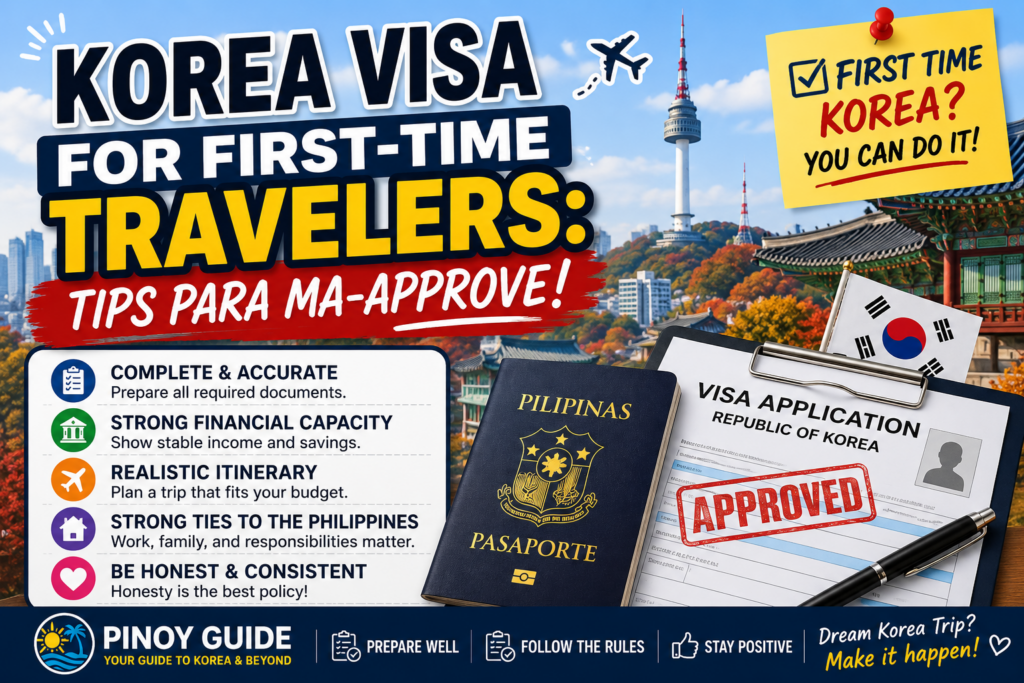
Planning your first trip to South Korea can be exciting. Seoul, Busan, Jeju, Korean food, K-pop, shopping, and beautiful tourist attractions are enough reasons para gustong-gustong pumunta ng maraming Filipinos sa Korea.
Pero bago ang lahat, may isang importanteng step: Korea tourist visa application.
Para sa first-time travelers, normal lang magkaroon ng maraming questions:
“Possible ba ma-approve kahit first time kong mag-abroad?”
“Wala akong previous Korea visa. Malaking disadvantage ba iyon?”
“Magkano ba dapat ang nasa bank account?”
“Kailangan bang maraming travel history?”
The good news is this: being a first-time traveler does not automatically mean your Korea visa will be denied.
What matters more is whether your application clearly shows that you have a legitimate reason to travel, enough financial capacity for the trip, and strong reasons to return to the Philippines.
Here are practical tips that can help you prepare a stronger Korea visa application in 2026.
Can First-Time Travelers Get a Korea Visa?
Yes.
You do not need to have visited Japan, Singapore, Europe, or other countries before applying for a Korean tourist visa.
Previous international travel may support your application, but travel history is not the only factor considered in a visa application.
For employed applicants, the Korean Embassy’s current C-3 short-term visit requirements include documents such as the visa application form, passport, Certificate of Employment, personal bank certificate, and ITR/Form 2316. Previous OECD visas and arrival stamps are listed only “if applicable.”
So kung first international trip mo ang Korea, huwag agad mawalan ng confidence.
Instead, focus on making the rest of your application strong and consistent.
1. Make Sure Your Documents Tell the Same Story
One of the most important things in any visa application is consistency.
For example, suppose your Certificate of Employment says you earn ₱30,000 per month.
Then your bank account suddenly shows ₱500,000 deposited shortly before your visa application.
That doesn’t automatically mean rejection, but it can create questions about where the money came from.
Your employment, income, savings, travel budget, and itinerary should make sense together.
Think of your visa application as one story:
Who are you? Why are you traveling? How will you pay for the trip? And why will you return to the Philippines?
If your documents answer those questions clearly, your application becomes easier to understand.
2. Your Bank Account Should Look Natural
Many first-time applicants focus too much on one question:
“Magkano dapat ang bank balance?”
There is no single magic amount that guarantees approval.
Instead of trying to reach an arbitrary balance, prepare financial documents that realistically support your planned trip.
For employed applicants, the Embassy’s requirements specify that the personal bank certificate should include information such as the account name, account number, account type, current balance, account opening date, and six-month average daily balance (ADB).
That is why suddenly borrowing a large amount of money just to make your account look stronger is not a good strategy.
A bank account showing regular savings and normal financial activity can tell a more believable story than an unusually large last-minute deposit.
3. Match Your Travel Budget to Your Financial Capacity
Your itinerary should also be realistic.
If your income and savings are modest, submitting an extremely expensive two-week luxury itinerary may create unnecessary questions.
A simple five- or six-day Seoul trip can sometimes make much more sense.
For example, your planned expenses may include:
- Round-trip airfare
- Hotel accommodation
- Transportation
- Food
- Attraction tickets
- Shopping
- Emergency allowance
You don’t need to pretend that you’re a luxury traveler.
A realistic trip you can genuinely afford is better than an impressive-looking itinerary that doesn’t match your finances.
4. Employment Stability Can Help Your Application
If you’re employed, your Certificate of Employment is an important part of the application.
According to the Embassy’s published requirements for employed applicants, the COE should contain information including your position, hiring date, compensation, office address, HR landline number, and HR email address.
This document does more than show your salary.
It can also help establish that you have an ongoing job in the Philippines.
That matters because visa assessment isn’t only about whether you can afford Korea.
The application should also make sense as a temporary visit.
If you’ve been working for the same company for several years, for example, that employment history may help make your overall profile easier to understand.
5. Self-Employed Applicants Should Prepare Business Documents Carefully
If you’re a business owner, freelancer, or self-employed, your situation is different from that of a regular employee.
Your application should clearly demonstrate where your income comes from.
Depending on your applicant category, this may involve business registration, tax documents, bank records, permits, or other evidence of legitimate economic activity.
Don’t submit unrelated documents simply because you think “more documents = higher approval chance.”
The better strategy is:
Submit the required documents and make sure they clearly support your actual situation.
6. Don’t Fake Hotel, Employment, or Financial Documents
This should be obvious, but it is worth emphasizing.
Never submit fake:
- Employment certificates
- Bank documents
- Tax documents
- Business registrations
- Invitations
- Travel records
A visa refusal is bad enough.
Submitting fraudulent documents can create much more serious problems for future applications.
If your financial profile isn’t perfect, explain your real situation instead of trying to manufacture a stronger one.
7. Keep Your Itinerary Simple and Believable
First-time travelers sometimes create extremely detailed itineraries because they think it will impress the visa officer.
You don’t need to schedule every hour of your trip.
A straightforward itinerary might look like:
Day 1: Arrival in Seoul and hotel check-in
Day 2: Gyeongbokgung Palace, Bukchon, Insadong
Day 3: Myeongdong and N Seoul Tower
Day 4: Day trip outside Seoul
Day 5: Hongdae and shopping
Day 6: Departure for Manila
That’s easy to understand and perfectly reasonable for a tourist.
The itinerary should support your stated purpose: tourism.
8. A Cover Letter Can Help in Special Situations
A cover letter is not something you should use to invent explanations.
But it can be useful when something in your application needs context.
Examples include:
You recently changed jobs.
You don’t have an ITR for a legitimate reason.
Someone else will sponsor your trip.
You received a significant legitimate deposit.
Your employment arrangement is unusual.
You are traveling with family members who will shoulder some expenses.
Keep the letter short and factual.
Don’t write a dramatic essay asking the Embassy to approve your visa.
Explain the situation clearly and provide supporting documents where appropriate.
9. No ITR? Check Whether an Exemption Applies to You
This is particularly important in 2026.
The Korean Embassy in the Philippines has extended its simplified visa-document program from January 1 through December 31, 2026 for certain eligible applicants.
Eligible categories include certain elected politicians, specified professional-license holders, and qualifying principal credit-card holders.
For eligible credit-card applicants, certain cards from BDO, BPI, RCBC, Metrobank and PNB are included in the program. Qualified applicants may be exempt from submitting the bank certificate, bank statement, and ITR, although other general visa requirements remain.
So before assuming that your missing ITR will automatically cause a problem, check whether you qualify under the current simplified-document rules.
10. Don’t Assume an Expensive Trip Gives You Better Approval Chances
Visa approval isn’t a competition about who can spend the most.
Booking an expensive hotel or planning a huge shopping budget doesn’t automatically make your application stronger.
Actually, if the planned expenses don’t match your income, they may make the application less convincing.
For first-time travelers, financial consistency is more important than showing off financial capacity.
Plan the Korea trip that fits your real budget.
11. Previous Travel History Is Helpful—but Not Mandatory
If you’ve traveled abroad before and followed immigration rules properly, include relevant travel information when required.
But if you have never left the Philippines, don’t panic.
The Embassy’s current employee requirements describe visas and arrival stamps from OECD member countries during the previous five years as applicable only when the applicant has them.
That means a blank passport isn’t automatically the end of your Korea travel plans.
Your first international destination can still be Korea.
12. Don’t Buy Non-Refundable Tickets Just to Make Your Application Look Stronger
Another common mistake is spending too much money before visa approval.
Some applicants believe fully paid airline tickets prove that they’re serious travelers.
But spending money does not guarantee visa approval.
Whenever possible, avoid putting yourself in a situation where visa refusal would cause a major financial loss.
The objective is to prove that you’re a legitimate tourist—not to prove that you’re willing to risk your savings.
13. Apply Early Enough
Visa processing times can change depending on application volume and Embassy policy.
As of June 15, 2026, the Korean Embassy in the Philippines announced that the processing period for short-term visit (C-3) visas had been reduced from 12 to approximately 10 working days.
However, applicants should still avoid applying too close to their intended departure date.
Processing periods can change again, additional documents may be requested, and holidays can affect your travel preparation.
Give yourself enough allowance.
14. Don’t Compare Your Application Too Much With Other People
You’ll probably see posts online like:
“₱50,000 lang bank balance ko, approved!”
or
“₱300,000 bank balance ko pero denied!”
These stories can be interesting, but they don’t reveal the applicant’s entire profile.
One applicant may have stable employment.
Another may have irregular income.
Another may be sponsored by family.
Another may have extensive travel history.
Another may have inconsistent documents.
Visa applications are assessed individually.
So don’t copy someone else’s bank balance, itinerary, or strategy blindly.
What Makes a Strong First-Time Korea Visa Application?
For a first-time Filipino traveler, think about four things:
Consistency. Financial capacity. Credible travel purpose. Strong ties to the Philippines.
Your salary doesn’t need to be enormous.
Your bank account doesn’t need to contain millions.
And your passport doesn’t need to be full of immigration stamps.
What matters is whether your documents make sense when viewed together.
A simple applicant profile can still be convincing:
Stable job + reasonable savings + realistic five-day Korea itinerary + complete documents.
That tells a much clearer story than:
Low declared income + sudden huge bank deposit + expensive 15-day itinerary + questionable supporting documents.
Final Thoughts
Applying for your first Korea visa can feel intimidating, especially when you read visa approval and denial stories on social media.
But don’t approach the application by trying to guess a secret formula.
There isn’t one.
Prepare accurate documents, show your genuine financial situation, plan a trip you can realistically afford, and make sure everything in your application is consistent.
Most importantly, never alter your real situation just to make your application look stronger.
First-time traveler ka man, possible pa rin ang Korea.
Prepare well, apply honestly, and let your documents tell a clear and credible story.
Because visa requirements and procedures can change, applicants should always check the latest announcements from the Embassy of the Republic of Korea in the Philippines before submitting an application.
Recommended Tags
Korea Visa, Korea Visa Philippines, Korea Visa 2026, Korea Tourist Visa, Korea Visa for Filipinos, First Time Traveler Korea, Korea Visa Approval Tips, Korea Visa Requirements, Korea Visa Bank Balance, Korea Visa ITR, Korea Travel Philippines, Seoul Travel, Korean Visa Application, Korea Visa Tips, PINOY GUIDE
PINOY GUIDE





Comments 0
Be the first to comment..