
Grocery Budget Philippines 2026: Magkano ang Kailangan Bawat Buwan?
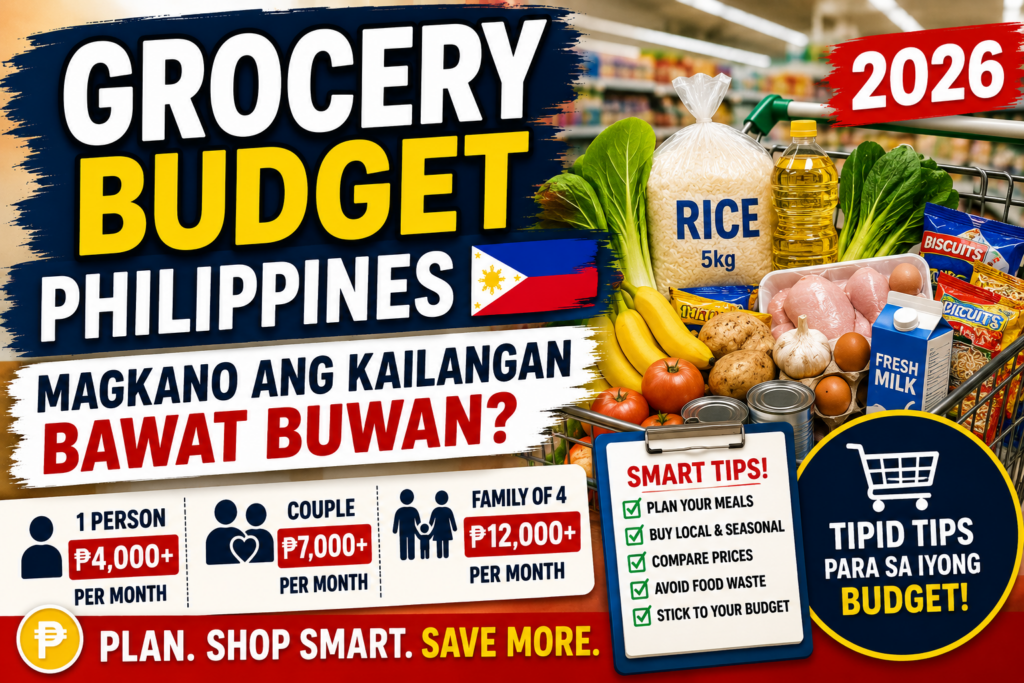
Magkano ba talaga ang kailangan para sa groceries bawat buwan sa Pilipinas?
₱3,000? ₱5,000? ₱10,000? O baka ₱20,000以上 para sa isang pamilya?
Simple ang tanong, pero walang iisang sagot.
Malaki ang difference depende sa number of family members, location, eating habits, supermarket, brands, at kung gaano kadalas kumain sa labas.
At ngayong 2026, mas importante nang planuhin nang maayos ang grocery budget.
According to the Philippine Statistics Authority (PSA), national food inflation was 5.3% in July 2026, meaning food prices overall were higher than a year earlier.
So, how much should you realistically prepare?
Here is a practical 2026 grocery budget guide for households in the Philippines.
Quick Answer: Magkano ang Grocery Budget Bawat Buwan?
For basic planning, a reasonable starting range can look like this:
| Household | Tipid Budget | Comfortable Budget |
|---|---|---|
| 1 person | ₱4,000–₱6,000 | ₱7,000–₱10,000 |
| Couple | ₱7,000–₱10,000 | ₱12,000–₱16,000 |
| Family of 3 | ₱10,000–₱14,000 | ₱15,000–₱21,000 |
| Family of 4 | ₱12,000–₱17,000 | ₱18,000–₱25,000+ |
| Family of 5 | ₱15,000–₱21,000 | ₱23,000–₱30,000+ |
Important: These are practical planning estimates, not official government-standard budgets.
Actual spending can be significantly lower or higher depending on where you live and what you buy.
A household buying mostly rice, vegetables, eggs, fish and local products from public markets can spend much less than a household buying imported meat, snacks, beverages and premium supermarket products.
Bakit Mahirap Magbigay ng Exact Grocery Budget?
Because grocery spending is very personal.
Imagine two families with four members.
Family A
Buys rice in bulk, shops at the palengke, cooks almost every meal at home and mostly chooses local products.
Family B
Shops at major supermarkets, regularly buys imported products, beef, cheese, cereal, snacks, soft drinks and branded household products.
Parehong four-person family sila.
Pero maaaring napakalaki ng difference sa monthly grocery bill nila.
Location matters too.
Prices in Metro Manila, Cebu or other urban areas can differ from provincial markets. Even two supermarkets in the same city may have noticeably different prices.
That is why your shopping habits matter almost as much as family size.
Sample Grocery Budget for One Person
For a single person cooking most meals at home, let’s use ₱6,000 per month as an example.
A possible allocation:
Rice and carbohydrates — ₱700
Rice, bread, noodles, pasta and similar staples.
Meat and fish — ₱1,500
Chicken, pork, fish and occasional other proteins.
Vegetables and fruits — ₱1,200
Seasonal vegetables, bananas and other affordable fruits.
Eggs and dairy — ₱700
Eggs, milk and basic dairy products.
Cooking ingredients — ₱600
Cooking oil, soy sauce, vinegar, garlic, onions, seasonings and other pantry essentials.
Snacks and drinks — ₱600
Coffee, biscuits and simple snacks.
Household essentials — ₱700
Dishwashing liquid, detergent, tissue and similar household products.
TOTAL: approximately ₱6,000
This isn’t a fixed formula. It’s simply one way to divide a monthly budget.
Sample Grocery Budget for a Family of Four
Now let’s look at a four-person household.
Suppose the monthly target is ₱18,000.
One possible breakdown would be:
| Category | Monthly Budget |
|---|---|
| Rice & staples | ₱2,500 |
| Meat & poultry | ₱4,000 |
| Fish & seafood | ₱2,000 |
| Vegetables & fruits | ₱3,000 |
| Eggs & dairy | ₱1,500 |
| Cooking ingredients | ₱1,500 |
| Snacks & beverages | ₱1,500 |
| Household supplies | ₱2,000 |
| Total | ₱18,000 |
This comes to approximately ₱600 per day for the household.
Again, actual costs depend heavily on diet and shopping habits.
Food Prices Are Still Important in 2026
Grocery budgeting deserves more attention this year.
PSA reported that food inflation reached 5.3% nationally in July 2026. Cereals and cereal products, including rice, were the largest contributor to food inflation, while fish and seafood and vegetables were also significant contributors.
For lower-income households, the pressure was even stronger. PSA reported 8.5% food inflation for the bottom 30% income households in July 2026, with rice prices being a major driver.
That means a grocery budget that worked last year may no longer be enough today.
Palengke vs Supermarket: Saan Mas Makakatipid?
One of the easiest ways to control your grocery spending is to choose where you buy each type of product.
Palengke
Usually worth checking for:
Fresh vegetables
Fish and seafood
Some meats
Fruits
Local ingredients
The advantage is that you can compare several vendors and buy smaller quantities.
Supermarket
Often more convenient for:
Packaged foods
Cooking ingredients
Milk
Canned goods
Frozen products
Household supplies
Personal-care products
Supermarkets also make prices easier to compare because products are standardized.
Warehouse or Bulk Shopping
Good for products you consume regularly:
Rice
Cooking oil
Detergent
Tissue
Canned goods
Beverages
But there’s a catch.
Bulk buying only saves money if you actually use everything.
Buying ₱3,000 worth of discounted products that you didn’t need isn’t saving ₱500.
It’s spending ₱2,500 unnecessarily.
The ₱1,500 Weekly Grocery Method
For someone with a ₱6,000 monthly grocery budget, one simple strategy is:
Week 1 — ₱1,500
Week 2 — ₱1,500
Week 3 — ₱1,500
Week 4 — ₱1,500
This is often easier than spending ₱6,000 at the beginning of the month.
Why?
Because weekly limits make overspending more visible.
If you spend ₱2,300 during the first week, you’ll immediately know that something needs to change.
For a family with an ₱18,000 budget, the same concept gives roughly:
₱4,500 per week.
Simple, but effective.
Biggest Grocery Budget Killers
Sometimes the expensive part isn’t rice or vegetables.
It’s everything else that slowly enters the cart.
Snacks
₱50 here, ₱100 there doesn’t feel expensive.
But ₱100 of unnecessary snacks five times a week is already roughly:
₱2,000 per month.
Soft Drinks and Bottled Beverages
Water is inexpensive.
Regularly buying soda, juice, energy drinks and bottled coffee can add thousands of pesos to household spending.
Imported Products
Imported cereals, sauces, cheese, meat, Korean/Japanese products and Western snacks can quickly increase your grocery bill.
There’s nothing wrong with buying them.
But they should be considered premium purchases, not basic necessities, when you’re trying to control a budget.
Food Waste
This is probably one of the most overlooked expenses.
You buy vegetables.
You don’t cook them.
They spoil.
You throw them away.
Then you buy them again.
The cheapest grocery item is still expensive if it ends up in the trash.
How to Save ₱2,000–₱5,000 Per Month on Groceries
You don’t necessarily need extreme budgeting.
Start with a few practical changes.
Make a grocery list before leaving home.
No list usually means more impulse purchases.
Plan meals for several days.
If you know what you’ll cook, you know what ingredients you actually need.
Compare price per unit, not just package price.
A bigger package isn’t automatically cheaper.
Check the price per gram, kilogram or liter.
Buy seasonal vegetables and fruits.
Prices can change considerably depending on supply.
Separate needs from wants.
Rice, eggs and vegetables?
Needs.
Three bags of chips because they’re on sale?
Probably wants.
Track your spending for one month.
This is the most important step.
You can’t improve a budget you don’t measure.
Try the 70-20-10 Grocery Rule
Here’s another simple system.
Suppose your monthly grocery budget is ₱15,000.
70% — Essential Food
₱10,500
Rice, meat, fish, vegetables, eggs and basic cooking ingredients.
20% — Household & Convenience Items
₱3,000
Cleaning supplies, toiletries, canned food and other household essentials.
10% — Treats
₱1,500
Snacks, desserts, soft drinks and non-essential purchases.
The advantage?
Hindi mo kailangang alisin lahat ng gusto mong kainin.
You simply put a limit on them.
Is ₱10,000 Enough for a Family of Four?
Possible?
Yes.
Easy?
Probably not for many households.
A ₱10,000 budget equals roughly:
₱333 per day for the entire household.
It requires careful meal planning, local ingredients, limited snacks and beverages, and frequent price comparison.
A more flexible target for many four-person households could be around ₱15,000–₱20,000 per month, although spending can easily exceed ₱20,000 depending on location and diet.
Is ₱20,000 Enough?
For many households, ₱20,000 provides considerably more flexibility.
That’s around:
₱667 per day.
It allows more variety in proteins, fruits, dairy products and household necessities.
However, a family that regularly buys premium meat, imported food, branded snacks and beverages could still exceed this amount.
What Do Filipino Families Actually Spend?
The latest comprehensive Family Income and Expenditure Survey currently available from PSA is the 2023 FIES.
It estimated average annual family expenditure across all categories at approximately ₱258,050 in 2023, while average annual family income was around ₱353,230.
PSA’s FIES microdata also reports mean total food expenditure of about ₱101,708 annually, which works out to roughly ₱8,476 per month when simply divided by 12. However, this figure covers the survey’s defined total food consumption category and comes from 2023—not today’s 2026 grocery prices—so it should not be treated as a current grocery-budget target.
That’s why current household planning should consider both official statistics and your family’s actual purchasing habits.
Metro Manila vs Provinces
Location can make a big difference.
Interestingly, inflation itself also varies considerably by region.
In July 2026, PSA reported overall inflation of 4.4% in NCR, compared with 6.7% in areas outside NCR.
That doesn’t automatically mean every grocery item is cheaper in Metro Manila. It means price movements differ across regions.
Local supply, transportation, supermarkets, public markets and competition can all affect what you actually pay.
So instead of asking:
“Ano ang average grocery budget sa Pilipinas?”
A better question is:
“Magkano ang kailangan ng household namin sa city namin?”
A Better Way to Set Your Grocery Budget
Instead of copying someone else’s budget, try this for one month:
Step 1: Save every grocery receipt.
Step 2: Separate food from household supplies.
Step 3: Divide food into essentials and non-essentials.
Step 4: Check which items are repeatedly wasted.
Step 5: Set next month’s budget about 5–10% below unnecessary spending—not below essential nutrition.
For example:
Current spending: ₱22,000
Necessary groceries: ₱17,000
Impulse purchases: ₱3,000
Food waste / unnecessary bulk buying: ₱2,000
New target:
₱17,000–₱19,000
That’s much more realistic than suddenly trying to survive on ₱10,000.
Final Thoughts
So, magkano ang kailangan para sa groceries bawat buwan sa Pilipinas in 2026?
There’s no single correct number.
But as a practical starting point:
Single person: around ₱4,000–₱10,000
Couple: around ₱7,000–₱16,000
Family of four: around ₱12,000–₱25,000+
The biggest factor isn’t only how much food costs.
It’s how you shop.
Buying local products, comparing prices, planning meals, reducing food waste and controlling impulse purchases can make a surprisingly large difference over an entire year.
At kung gusto mong malaman kung sapat ang budget mo, don’t compare yourself too much with other households.
Track your own spending for 30 days.
That’s where a realistic grocery budget begins.
FAQ
Magkano ang grocery budget ng isang tao sa Pilipinas?
Around ₱4,000–₱10,000 per month can be a useful planning range depending on location, diet and shopping habits.
Magkano para sa family of four?
A practical starting range could be around ₱12,000–₱25,000+ per month. Families buying mostly local products can potentially spend less, while premium or imported groceries can push the total much higher.
Mas mura ba sa palengke kaysa supermarket?
For many fresh products, palengke can offer competitive prices, but not every item is automatically cheaper. Compare prices whenever possible.
Kasama ba ang pagkain sa labas?
The sample budgets in this guide are primarily intended for groceries and household food consumed at home. Restaurant meals, food delivery and frequent takeout should ideally have a separate budget.
Bakit tumataas ang grocery expenses?
Food inflation, changing supply conditions, transportation costs and individual purchasing habits can all contribute. PSA reported national food inflation of 5.3% in July 2026.
Sources
Philippine Statistics Authority (PSA) — Consumer Price Index and Inflation Rate, July 2026.
Philippine Statistics Authority (PSA) — CPI for Bottom 30% Income Households, July 2026.
Philippine Statistics Authority (PSA) — 2023 Family Income and Expenditure Survey (FIES).
Recommended Tags: Grocery Budget Philippines, Philippines Cost of Living, Grocery Prices Philippines 2026, Monthly Budget Philippines, Family Budget Philippines, Tipid Tips, Palengke Philippines, Food Budget Philippines, Philippines Living Expenses, PINOY GUIDE
PINOY GUIDE


Comments 0
Be the first to comment..