
Best Korean Ramen for Filipinos: 7 Ramyeon to Try from Mild to Spicy
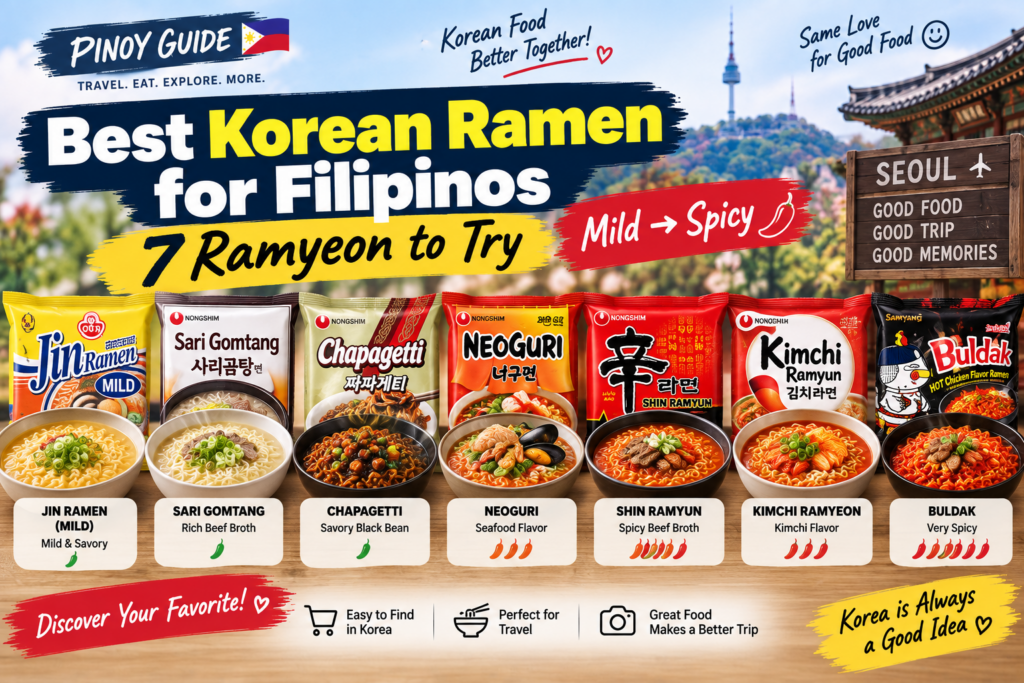
Mahilig ang maraming Filipino sa instant noodles, kaya kapag pumunta ka sa Korea, isang buong shelf ng Korean ramyeon sa convenience store can feel both exciting and confusing.
Shin Ramyun? Jin Ramen? Buldak? Chapagetti? Neoguri?
Alin ba ang masarap kung sanay ka sa Filipino taste?
Korean ramyeon comes in many styles—from mild and savory soup noodles to seafood flavors and extremely spicy stir-fried noodles. VISITKOREA even highlights ramyeon as one of Korea’s popular must-buy foods, including well-known names such as Shin Ramyun, Neoguri, Buldak Bokkeummyeon and Chapagetti.
Here are 7 Korean ramyeon worth trying, depending on how spicy and adventurous you want to go.
Quick Guide: Ano ang bagay sa iyo?
Pumili ayon sa flavor, exact variant at cooking style. Ang listahang ito ay gabay sa pagpili; magkakaiba ang panlasa at heat tolerance ng bawat tao.
| Option | Style | Check before buying |
|---|---|---|
| Jin Ramen Mild | Mild-style soup noodles | Look for Mild / 순한맛; Jin has other heat variants. |
| Sari Gomtang | Savory gomtang-style soup | Check the actual ingredients and seasoning instructions. |
| Chapagetti | Jjajang-style sauce noodles | Read the draining and sauce-mixing instructions. |
| Neoguri Spicy | Thick noodles, spicy seafood-style soup | Check Spicy versus Mild; the brand has both. |
| Shin Ramyun Original | Spicy soup noodles | Confirm the exact variant and your own spice preference. |
| Kimchi-style ramyeon | Kimchi flavor; varies by product | Pick an actual brand/variant and check its preparation. |
| Buldak Original | Spicy sauce noodles | Follow the packet’s draining and sauce steps; check the cup separately. |
Ang Ottogi Jin lineup ay may Mild, Spicy at bahagyang spicy na variants. Ipinapakita rin ng Nongshim Neoguri catalog ang Spicy at Mild options. Tingnan ang mismong variant sa shelf, hindi brand name lang.
Variant and preparation comparison checked: October 24, 2026.
1. Jin Ramen Mild — Best for Beginners
Kung first time mong kakain ng Korean ramyeon at hindi ka mahilig sa sobrang anghang, Jin Ramen Mild is one mild-style option to consider.
May flavorful soup siya without making the spice the main attraction.
In fact, VISITKOREA specifically includes Jin Ramen Mild among its recommendations for travelers looking for non-spicy cup noodles.
Best for: Families, beginners, at travelers na gusto muna ng mild Korean noodles.
2. Sari Gomtang — Para sa Ayaw ng Maanghang
If spicy food isn’t your thing, try Sari Gomtang.
Gomtang refers to a Korean-style beef soup, so the flavor profile is more savory and comforting than fiery.
VISITKOREA also recommends Sari Gomtang as a non-spicy ramyeon option.
Para sa Filipino na mahilig sa warm, savory noodle soup, this is one of the easiest Korean ramyeon styles to enjoy.
Best for: People seeking a savory soup style; check ingredients and preparation for the person who will eat it.
3. Chapagetti — Something Completely Different
Chapagetti isn’t your typical soup noodles.
It’s Nongshim’s instant-noodle interpretation of jjajangmyeon, Korea’s black-bean-sauce noodles. VISITKOREA also identifies Chapagetti as a ramyeon version of jjajangmyeon.
The result is dark, savory and slightly sweet rather than spicy soup.
Don’t expect it to taste like Filipino pancit canton. It’s a different flavor experience.
One simple way to make it more filling is adding fried egg; Nongshim itself features a Chapagetti recipe using egg and cheese.
Best for: Travelers who want to try Korean noodles without relying on spicy broth.
4. Neoguri — For Seafood Lovers
Mahilig ka ba sa seafood-flavored noodles?
Try Neoguri.
Its defining combination is thicker, chewy noodles and spicy seafood-style broth, with kelp being one of its recognizable ingredients.
This description refers to Neoguri Spicy. Nongshim also lists Neoguri Mild, so choose the exact variant rather than assuming every Neoguri pack has the same heat.
For Filipinos who enjoy seafood soups, this can be more familiar than some other Korean flavors.
Pero may spice pa rin, so don’t assume seafood means mild.
Best for: Seafood lovers and people who enjoy thicker noodles.
5. Shin Ramyun — The Korean Classic
Kung isang Korean ramyeon lang ang gusto mong subukan, Shin Ramyun is an obvious candidate.
Nongshim describes it as combining spicy flavor with a deep beef broth and chewy noodles, and says the product is sold in more than 100 countries.
The important warning for Filipino travelers:
It is genuinely spicy.
VISITKOREA’s CU Ramyun Library guide classifies Shin Ramyun as “VERY HOT,” level 4 on that store’s five-level scale.
Kung sanay ka sa spicy food, masarap ang balance ng heat at savory broth.
Kung hindi, start with something milder.
Best for: Anyone wanting the classic Korean spicy-ramyeon experience.
6. Kimchi Ramyeon — For Kimchi Lovers
Kung gusto mo ang combination ng maasim, savory at spicy, try a kimchi-style ramyeon.
There are several products in this category, and convenience stores may also carry store-exclusive varieties.
For example, VISITKOREA highlights Omori Kimchi Jjigae Ramyeon, available at GS25, for its kimchi-stew-and-ramyeon combination.
The fermented kimchi flavor gives the broth more acidity and depth than ordinary spicy noodles.
Best for: People who already enjoy kimchi and kimchi jjigae.

7. Buldak — For Serious Spice Lovers
And then there’s Buldak.
This is not the one I’d recommend as your first Korean ramyeon if you’re sensitive to spice.
Unlike typical soup ramyeon, Buldak is famous for its intensely spicy hot-chicken-style noodles. VISITKOREA lists Buldak Bokkeummyeon among Korea’s popular ramyeon and specifically associates it with intense spiciness.
If you already enjoy very spicy food, it can be fun.
If not, don’t choose it just because you’ve seen the viral spicy-noodle challenges.
Best for: Serious spicy-food fans.
What Should Filipinos Try First?
If you’re buying only three, I’d choose them like this:
Not good with spicy food → Jin Ramen Mild
Want the classic Korean experience → Shin Ramyun
Want something different → Chapagetti
Then try Neoguri if you love seafood and Buldak only if you really enjoy strong heat.
Soup, Sauce or Cup: Read the Cooking Method First
Soup noodles and sauce noodles need different preparation. For example, Samyang America’s Buldak Original packet directions say to drain most of the water before adding sauce and stir-frying. Use that as a packet example, and follow the directions on the version you actually bought for water amount, timing and sauce order.
For cups, check whether the product uses hot water, needs draining or allows microwave cooking. Follow the lid, sachet and container instructions. A familiar brand name does not make the bag and cup recipes interchangeable.
Check ingredient and allergen statements separately from heat level. Nongshim notes that these statements can change and directs buyers to the actual package. A “mild” label describes the flavor choice; it does not establish dietary suitability.
How to Make Korean Ramyeon Taste Even Better
One fun thing about ramyeon is how easy it is to customize.
Try adding:
Egg — makes spicy broth richer.
Cheese — can soften the perception of strong spice and adds creaminess.
Green onion — freshens up the broth.
Kimchi — classic Korean side dish combination.
Samgak gimbap — triangle gimbap makes a simple convenience-store meal more filling.
VISITKOREA specifically recommends the convenience-store combination of ramyeon and samgak gimbap, and many Hangang convenience stores even have dedicated machines for cooking packet ramyeon.
If you’re visiting Seoul, eating freshly cooked convenience-store ramyeon beside the Hangang River is also a fun Korean travel experience.
Where Can You Buy Korean Ramyeon?
In Korea, ramyeon is easy to find at convenience stores and supermarkets. For ordering, heating, and pairing tips, see our Korean convenience store food guide.
CU, GS25, 7-Eleven, emart24, supermarkets and large marts.
If you are shopping locally, our Korean grocery stores in the Philippines guide explains what to buy and what to check before ordering chilled or frozen products.
If you want a bigger selection, VISITKOREA’s guide to the CU Ramyun Library in Hongdae describes a store displaying around 105 instant-noodle products, compared with around 30 varieties at a typical convenience store.
So if you’re staying in Seoul and love Korean noodles, it can be an interesting stop.
Final Recommendation
There isn’t one Korean ramyeon that’s automatically best for every Filipino.
If you prefer mild flavors, start with Jin Ramen Mild or Sari Gomtang.
For the classic spicy Korean experience, try Shin Ramyun.
Seafood lover? Neoguri.
Want something completely different? Chapagetti.
And if you’re the person who says “mas maanghang, mas masarap”—
then Buldak is waiting for you.
The fun part is trying several and discovering which Korean ramyeon matches your own Filipino taste.
Information checked: September 6, 2026.
PINOY GUIDE is an independent informational website and is not affiliated with the Korea Tourism Organization, Nongshim, Ottogi, Samyang Foods or any convenience-store chain. Product availability, recipes and ingredients may change. Travelers with food allergies or dietary restrictions should always check the current product label before eating.
Official Sources
Korea Tourism Organization (VISITKOREA) — Korean ramyeon and must-buy Korean foods.
VISITKOREA Korean Must-buy Items
Korea Tourism Organization (VISITKOREA) — CU Ramyun Library and ramyeon spice-level information.
VISITKOREA CU Ramyun Library Guide
Korea Tourism Organization (VISITKOREA) — Korean convenience-store food and ramyeon recommendations.
VISITKOREA Convenience Store Must-Eats
Nongshim — Official Shin Ramyun product information.
Nongshim Shin Ramyun






Comments 0
Be the first to comment..