
Seoul Subway Guide for Filipinos: Paano Gamitin?
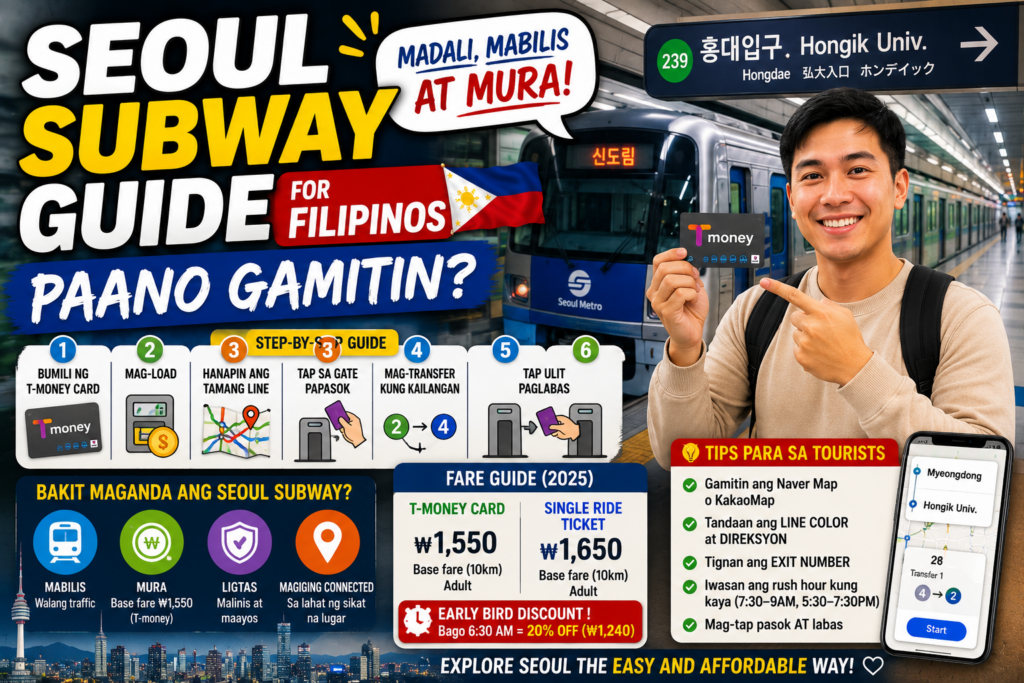
First time mo sa Seoul?
Pagtingin mo sa subway map, baka ito agad ang reaction mo:
“Ang daming linya! Paano ko ito gagamitin?”
Don’t worry.
The Seoul subway system may look complicated at first, but once you understand the basic system, isa ito sa pinakamadaling paraan para mag-travel around Seoul.
You don’t need to speak Korean.
Most major stations have English signs, station numbers and color-coded subway lines.
And with a T-money card and a navigation app on your phone, even first-time Filipino travelers can use the Seoul subway without much difficulty.
Here’s a simple step-by-step guide.
Bakit Maganda ang Seoul Subway for Tourists?
For most Filipino tourists, the subway is one of the best ways to explore Seoul.
Why?
Fast
Affordable
Clean
Reliable
and connected to most major tourist attractions.
You can easily reach places such as:
Myeongdong
Hongdae
Gyeongbokgung Palace
Dongdaemun
Gangnam
Seoul Station
Itaewon
and Jamsil.
Unlike taxis, you also don’t have to worry much about traffic.
For budget travelers, malaking advantage ito.
Step 1: Bumili ng T-money Card
The easiest way to use public transportation in Seoul is with a:
T-money Card
Think of it like a reloadable transportation card.
Instead of buying a subway ticket every time, simply:
Tap → Ride → Tap Out
You can use T-money on Seoul’s subway and buses and on many other public transportation systems throughout Korea.
For card price, purchase locations, loading and refund details, read our T-money Card Korea guide.
Saan Makakabili ng T-money?
T-money cards are widely available.
You can usually buy one at convenience stores displaying the T-money logo, including chains such as:
CU
GS25
and 7-Eleven.
Cards are also available from ticket/card machines at many subway stations.
The basic card itself normally costs a few thousand won, depending on the design and type.
Important:
Card price and transportation balance are separate.
So after buying the card, kailangan mo pa itong lagyan ng load.
Step 2: Mag-Load ng T-money
After purchasing the card, add money to it.
For example:
₩10,000
₩20,000
or ₩30,000
depending on how much transportation you expect to use.
For a short Seoul trip, there’s usually no need to load a huge amount immediately.
You can simply reload when the balance gets low.
Important Tip for Filipino Travelers
Keep some Korean won cash with you.
Transportation-card charging is commonly done using cash at subway charging machines and participating convenience stores, so don’t depend entirely on your Philippine credit card.
A practical approach is:
Load a reasonable amount first, then top up when needed.
Step 3: Hanapin ang Tamang Subway Line
This is the part that looks intimidating at first.
Seoul has many subway lines, but they’re organized using:
Numbers
Colors
Station names
and station numbers.
For example:
Line 1
Dark blue
Line 2
Green
Line 3
Orange
Line 4
Light blue
and so on.
For tourists, Line 2 and Line 4 are especially useful because they connect many popular areas.
The Seoul metropolitan subway network also extends beyond Seoul into parts of Gyeonggi Province and Incheon, so the map can look enormous.
But you don’t need to memorize it.
Don’t Memorize the Subway Map
This is probably the most useful advice for first-time visitors:
Don’t try to memorize the Seoul subway map.
Use a navigation app instead.
Two useful apps in Korea are:
Naver Map
and
KakaoMap.
Enter your destination and the app can show:
Which station to enter
Which subway line to take
Direction
Where to transfer
Number of stops
and which exit to use.
Google Maps can be useful for general location searches, but Korean local navigation apps are often more practical for detailed public-transport directions.
Step 4: Check the Direction Before Boarding
This is where first-time tourists often make mistakes.
Let’s say you’re at:
Myeongdong Station
and want to go to:
Dongdaemun History & Culture Park Station.
Both are on Line 4.
But Line 4 goes in two directions.
So simply finding:
Line 4
is not enough.
You need to check which direction the train is traveling.
Look at the station signs.
They usually show the:
Next station
and sometimes the major station in that direction.
Compare this with your navigation app.
If the next station shown on the platform matches the route on your app, you’re going the right way.
Step 5: Tap Your T-money Card
When you reach the subway gate, place your T-money card on the card reader.
You’ll hear a beep.
The gate opens.
Enter.
That’s it.
You don’t need to choose your destination before entering when using T-money.
The system calculates the fare based on your trip.
When you reach your destination:
Tap again when exiting.
This is important because the system needs your entry and exit information to calculate the correct fare.
Magkano ang Seoul Subway?
According to the Seoul Metropolitan Government’s current official fare information, the adult base subway fare is:
T-money / Transportation Card
₩1,550
Single-Ride Ticket
₩1,650
The base fare generally covers the initial 10 km, with additional distance charges applying to longer trips.
So for many ordinary trips around central Seoul, transportation is relatively affordable compared with taking taxis.
May Discount Ba?
Yes.
An interesting Seoul transportation rule is the:
Early Morning Discount
If you use a transportation card for your first ride before 6:30 AM, a 20% early-morning discount applies under Seoul’s fare system.
For an adult subway passenger, the discounted base fare is currently:
₩1,240.
Most tourists probably won’t plan their vacation around this discount, but it’s useful if you’re heading out very early.
Puwede Bang Bumili ng Single-Ride Ticket?
Yes.
If you don’t have a T-money card, you can purchase a:
Single Journey Ticket
from a ticket vending machine.
But for tourists using the subway repeatedly, T-money is usually more convenient.
With a single-ride ticket, you need to purchase a ticket for each trip.
With T-money:
Tap and go.
You can also use the same card for buses, which makes transfers much easier.
Step 6: Paano Mag-Transfer?
Let’s say your route requires:
Line 4 → Line 2
You normally don’t need to exit the station.
Look for signs saying:
Transfer
and follow the color and number of the subway line you need.
For example:
Transfer to Line 2
Follow the arrows.
Eventually, you’ll reach the Line 2 platform.
You usually don’t need to tap out and tap back in for a normal subway-to-subway transfer inside the paid area.
This is one reason the Seoul subway system becomes surprisingly easy once you’ve used it a few times.
Subway + Bus Transfer
T-money becomes even more useful when combining:
Subway + Bus
or
Bus + Subway.
Seoul uses an integrated transportation fare system.
For eligible transfers, the fare is calculated based on the transportation system’s transfer rules rather than simply charging a completely separate full base fare every time.
The important rule is:
Always tap your card.
For buses, tap when boarding and when getting off.
Transfers generally need to be made within 30 minutes, extended to 60 minutes between 9 PM and 7 AM, under Seoul’s integrated fare rules.
Step 7: Count the Stations
Once you’re on the train, don’t panic about missing your stop.
Seoul subway trains generally provide:
Digital displays
Station announcements
Korean and English information
and station numbers.
Simply monitor your route.
Your navigation app will also tell you how many stations remain.
Example:
5 stops remaining
↓
3 stops
↓
Next stop: your destination
Get ready before your station arrives.
Step 8: Check Your Exit Number
This is extremely important in Seoul.
Large subway stations can have many exits.
Sometimes:
Exit 1
and
Exit 10
can put you on completely different sides of a major intersection or several minutes apart.
So don’t just search:
“Which station?”
Also check:
“Which exit?”
For example, your destination might say:
Myeongdong Station Exit 6
or
Hongik University Station Exit 9.
Your navigation app usually shows the recommended exit.
This can save a lot of unnecessary walking.
Important Tip: Big Stations Can Be Huge
Stations such as:
Seoul Station
Gangnam
Express Bus Terminal
Dongdaemun History & Culture Park
and other major transfer stations can be large.
Transferring between lines can involve several minutes of walking.
So when an app says:
25-minute subway trip
don’t assume you’ll arrive exactly 25 minutes after entering the station.
For important schedules, allow extra time for:
Walking
Transfers
Finding exits
and crowds.
Rush Hour: Kailan Dapat Iwasan?
Seoul subway can become extremely crowded during commuting hours.
Especially around:
7:30–9:00 AM
and
5:30–7:30 PM.
Exact crowd levels vary by line and station, but if you’re sightseeing and have a flexible schedule, avoiding peak commuting periods can make your trip much more comfortable.
This is especially useful if you’re traveling with:
Children
Elderly family members
or large luggage.
Important Subway Etiquette
Korea has some public transportation customs worth knowing.
Priority Seats
There are designated seats for:
Elderly passengers
Pregnant women
Passengers with disabilities
and others who need priority seating.
Even when empty, it’s best for tourists to respect these designated areas.
Keep Your Voice Down
Subway trains are generally quieter than public transportation in some countries.
Avoid:
Loud conversations
Speakerphone calls
and playing videos without earphones.
Let Passengers Exit First
When the train arrives:
Stand to the side of the door.
Let passengers exit.
Then board.
Simple rule, but very important during rush hour.
Traveling With Luggage
If you’ve just arrived from the Philippines with a large suitcase, subway travel is possible—but not always comfortable.
Many stations have:
Elevators
and escalators,
but you may still need to walk considerable distances.
During rush hour, carrying a large suitcase on crowded trains can be stressful.
If your hotel is close to a subway station and you’re traveling outside rush hour, the subway can work well.
If you are still choosing a convenient neighborhood, compare the options in our Where to Stay in Seoul guide.
Otherwise, consider an airport train, airport bus or taxi depending on your luggage and destination.
From Incheon Airport to Seoul by Train
Many Filipino travelers arrive through:
Incheon International Airport.
One popular option is the:
Airport Railroad — AREX.
There are different services, including the regular All-Stop Train and the Express Train.
The All-Stop Train connects the airport with stations such as:
Hongik University
and Seoul Station.
Current official AREX fare tables list the All-Stop Train fare from Incheon Airport Terminal 1 to Seoul Station at ₩4,750, while Terminal 2 to Seoul Station is ₩5,350.
This makes the airport railroad a practical option for travelers staying around Hongdae or central Seoul.
How Much Should You Budget for Subway Transportation?
Let’s make a simple tourist example.
Suppose you take:
4 subway rides per day
at around the base fare.
₩1,550 × 4
= ₩6,200 per day
For five days:
₩6,200 × 5
= approximately ₩31,000
Actual cost may be higher or lower depending on distance, transfers and your itinerary.
But this shows why Seoul’s subway is useful for budget-conscious Filipino travelers.
Instead of relying heavily on taxis, public transportation can keep transportation costs manageable.
Common Mistakes ng First-Time Filipino Travelers
Mistake #1: Wrong Direction
Correct line, wrong direction.
Always check the next station before boarding.
Mistake #2: Wrong Exit
You reach the correct station but take the wrong exit.
Always check the exit number.
Mistake #3: Low T-money Balance
You arrive at the gate and don’t have enough balance.
Check and reload your card before long trips.
Mistake #4: Following Only Station Names
Some stations have similar names.
Use the station number + line color + station name together.
Mistake #5: Forgetting to Tap Out
Always tap your transportation card when exiting.
Mistake #6: Depending Completely on Google Maps
Install a Korean navigation app before your trip.
Naver Map or KakaoMap can make subway navigation much easier.
Simple Example: Myeongdong to Hongdae
Let’s say you’re staying in Myeongdong and want to visit Hongdae.
Your navigation app may give you a route involving a transfer.
The process is simply:
1. Open Naver Map or KakaoMap
↓
2. Search Hongdae/Hongik University
↓
3. Select public transportation
↓
4. Check the subway line and direction
↓
5. Tap T-money at the gate
↓
6. Follow transfer signs if needed
↓
7. Get off at Hongik University Station
↓
8. Check the recommended exit
That’s basically how most Seoul subway trips work.
Once you’ve done this two or three times, it becomes routine.
Frequently Asked Questions
Is the Seoul subway difficult for Filipino tourists?
Not really. The system looks complicated because there are many lines, but English signs, station numbers and navigation apps make it manageable even for first-time visitors.
How much is the Seoul subway fare?
The current adult base fare is ₩1,550 with a transportation card and ₩1,650 for a single ride, based on Seoul’s official fare information. Additional charges apply for longer distances.
Should I buy a T-money card?
For most tourists who plan to use public transportation several times, yes. It’s more convenient than buying individual tickets repeatedly.
Can I use T-money on buses?
Yes. T-money can be used on Seoul buses and many other transportation systems in Korea.
Do I need cash in Korea for transportation?
It’s useful to carry some Korean won, especially for topping up transportation cards.
What app should I use?
Naver Map and KakaoMap are useful choices for public transportation navigation in Korea.
What if I take the wrong subway?
Don’t panic. Get off at the next convenient station and use your navigation app to recalculate the route.
Is the subway safe?
Seoul’s subway is generally considered convenient and widely used by both residents and international travelers. As anywhere, keep track of your belongings, especially in crowded areas.
Final Takeaway
At first glance, the Seoul subway map can look overwhelming.
But you only need to remember a few things:
Buy a T-money card.
Load Korean won.
Use Naver Map or KakaoMap.
Check the subway line.
Check the direction.
Tap when entering and exiting.
Follow transfer signs.
Check your exit number.
That’s it.
For Filipino travelers visiting Seoul for the first time, the subway can save a significant amount of money compared with relying on taxis.
And after your first few rides, you’ll probably realize:
Hindi pala mahirap ang Seoul subway.
The map may look complicated, but the system itself is organized.
Once you understand how the lines, directions, transfers and exits work, exploring Seoul becomes much easier—and much cheaper.
Disclaimer: Subway fares, transportation-card policies, routes and operating conditions can change. Always check current information from Seoul Metropolitan Government, Seoul Metro, AREX or your navigation app before traveling.
Official Sources
Seoul Metropolitan Government — Subway. Official subway fare information and integrated transportation rules. Adult base fare is currently ₩1,550 using a transportation card and ₩1,650 for a single ride, based on fares effective June 28, 2025.
Korea Tourism Organization — Transportation Cards. Information about T-money usage, purchasing, charging and public transportation transfers.
Korea Tourism Organization — Subway Guide. Information about the Seoul Metropolitan Subway network, subway maps and transportation-card system.
Airport Railroad (AREX) — Official Website. Official train information and current fare guidance for Incheon Airport and Seoul-area stations.
Information checked: August 30, 2026
PINOY GUIDE





Comments 0
Be the first to comment..